
🦊 Jury Duty
When I got the summons in the mail, I was annoyed, but only a little, because I assumed nothing would come of it. Since moving to America two decades ago, I’ve been summoned for jury duty four times. Each time, I would dutifully call the number at the specified time, only to be told that my duty was completed, having done nothing at all.
That is what annoyed me most about the letter I held in my hand: it was a false promise (or idle threat, depending on how you view the duty.) I actually looked forward to serving on a jury, so for me, every letter was an annoying but predictable journey of hope, excitement, and disappointment.
I couldn’t help but take it a bit personally. My services were not needed. I was not wanted. Rejected outright, without so much as a chance to show my skills!
But this time was different. At first it seemed like a business as usual—when I called at the allotted time, it told me I had to call back at another time. (Great.) I was supposed to call the next day between 11am and 1pm. I decided that I would not call at 11am, and instead would wait until 12pm, as a form of rebellion, my personal protest expressing my disappointment in the failure of the system to properly appreciate my talents. Indeed, I was confident the robot answering machine receiving my call at 12 rather than 11 would understand the true meaning of the delay, and escalate the incident to the powers that be.
It was not my best idea. Not because the robot didn’t get the hint (there’s always a chance), but because when I finally called at 12pm, after aimlessly wandering around the house pretending to do other things, lifting up pieces of paper in a pretense of cleanup only to put them back down exactly where they were, finally choosing join my cats in the holy act of couch-laying. I accepted I would not be able to do anything other than think about the call until I made the damn call. This tends to happen whenever I have a scheduled appoint of any kind coming up later in the day—everything I try to do before that amounts to a distracted start followed by inevitable surrender to my brain’s desperate need to “sit and wait for scary thing, we must be ready.”
I made the call. The recording told me I needed to appear at the courthouse by 1pm. And the courthouse it specified was not the one nearest me, but a different California Superior Court, which was almost an hour away from me. I needed to leave immediately.
I never got the chance to bask in the excitement of my first jury summons. I was instead launched directly from stressed waiting into panicked rushing. This was my first call to arms (of a chair, obviously), and I was already late.
Oh God, what do they do to people who are late for jury duty? Do you get arrested? Does a policeman come to your house and drag you to the courthouse, where you are shamed by the judge in front of the entire courtroom? (The answer is a mix of yes’s and no’s, which I discovered the following day.)
Pajamas jettisoned, pants haphazardly pulled on, I ran to my car, only to realize I forgot the damn letter in the house, at which point I ran back to get it, but upon returning to the car I was no longer sure if I locked the house after the unexpected re-entry, and so I ran back to the door and was able to confirm that yes indeed I had locked it, and actually I always lock it, in fact my wife tells me not to double-check the lock because that only feeds into my OCD need to check, but I always double-check anyway, so now these unnecessary checks are a combination of anxiety (I will certainly be robbed within moments of leaving my door unlocked) and sheepish guilt (ignoring my wife’s advice never goes well).
By the time I made it out of my driveway, I was already exhausted, and already missed the couch desperately, and felt incredibly jealous of my cats, napping all day. No, I was not so lucky, for I had been summoned, and I had an important duty to fill! I had been called to serve, and I’d be damned if I’d let anything stop me. (Except the stop signs.)
I made it to the courthouse about five minutes before my appearance time. It was going to be tight. I hadn’t even parked yet and I was already confused. There was a “Jury Parking” sign with an arrow directing me to a lot, but inside said lot there was another sign that said “COURTHOUSE STAFF ONLY.”
I definitely did not want to park illegally at the courthouse. What if there were special penalties at a courthouse parking lot? What if when you park illegally at the courthouse, you just go straight to jail? No ticket, no trial. Special courthouse rules. Straight. To. Jail.
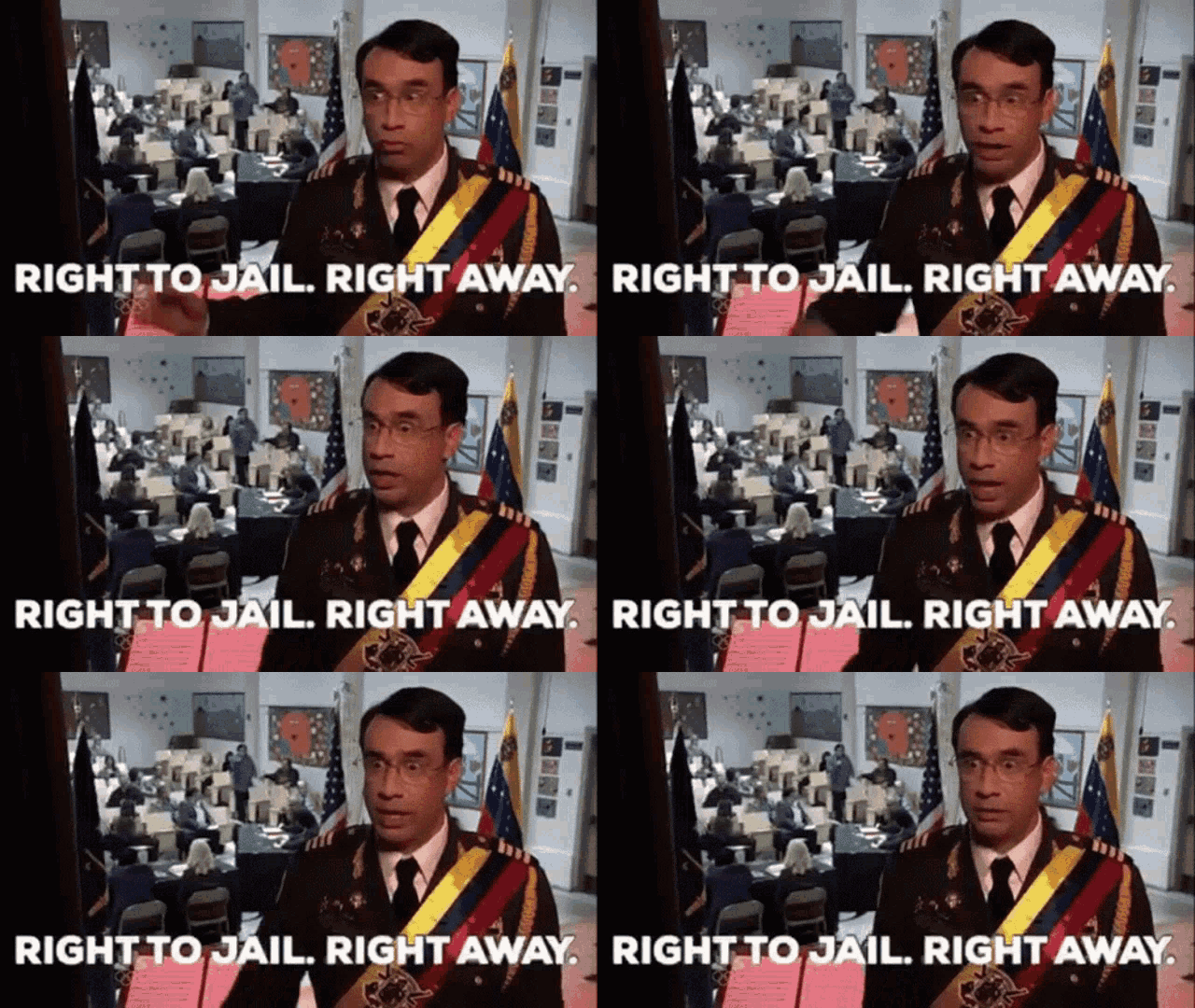
Needless to say, I was a bit stressed. I parked on the street, away from the courthouse, safely back into the regular jurisdiction of meter maids.
I walked around following the signs to enter, going around the grey box of a building with wired fences everywhere. It looked more like a prison than a courthouse. Around and around and around, until finally I got the entrance. There was a security check like TSA. I followed the yellow tape to check in for jury duty. I was a bit late, but it didn’t seem to matter. There was a room full of people waiting to be called, kind of like at the DMV.
As we waited, I started to sweat from the heat. Only after 20 minutes did an AC turn on, which told me they had set it to the absolute minimum. A man kept sighing loudly, hoping someone would look at him. He would not be the first person desperately trying to get attention. This whole process showed just how many people want interaction, any kind of interaction.
They played a training video about the importance of jury service, and how all law and justice depends on it. I liked it. I found myself getting into more and more of a positive mood as the day went on. It was the exact opposite of the DMV, I think because there was some hope of doing something useful in the process, unlike at the DMV which seems like an enforced experience of petty wastes of time.
They let us know it was time to go in. We went in a slow single file up the stairs. Before they let us in the courtroom, the bailiff said something about how they needed less than ten members selected to the jury, and so, most likely these would be picked from numbers 1-25, and that the remaining 26-55 would likely not be needed.
I looked down at my card showing the number 49. My heart sank. I would almost surely not be selected. I had hoped it would be a random selection from the 55, but no, they would go in sequence.
I trudged along into the courtroom and sat at the back, like a rebellious student who felt the system had failed him. That feeling of rejection wormed its way back into my stomach. With folded arms, I sat there as we waited for something to happen.
Then, finally, we heard the call: “All rise.”
The judge was in. I liked him immediately. He thanked us for being there, explained the importance of this process, and balanced the seriousness of the legal proceedings with a hint of humor. We were all a bit on edge, and he put us at ease. This is a difficult thing to do in a courtroom full of nervous people, but he managed it. I was impressed.
I also really liked the bailiff, who as the judge introduced as the one who is “responsible for the safety and dignity of the court, and is your liaison.” I liked that he used the word ‘dignity’ to describe the primary role of the bailiff. When I looked at the man, dignity was the word that came to mind. He had ran the room so nicely up to that point, leading everyone in gently but firmly. I respected him.
Despite the knowledge that I likely wouldn’t take any real part in this case, I found myself quite happy to be there, happy to listen to the proceedings, looking forward to staying as long as they’d let me.
The courtroom had strict rules to turn your phone off, not eat food, and so on. As a result, it is utterly silent aside from whatever is going on with the case. Everyone is giving each word their full attention. In our modern life of endless noise, the courtroom is a meditative escape.
Right before proceedings began, we were allowed to unholster our devices, and instructed to take a photo of the whiteboard, upon which the court schedule had been carefully written. I took the photo, but zoomed out a bit—I wanted to capture this. Later, I sketched the moment in my journal using fountain pen on Midori cream paper. I suspect, even without a caption, you can identify who among that bottom row is the defense lawyer, the people’s prosecution lawyer, and the defendant.
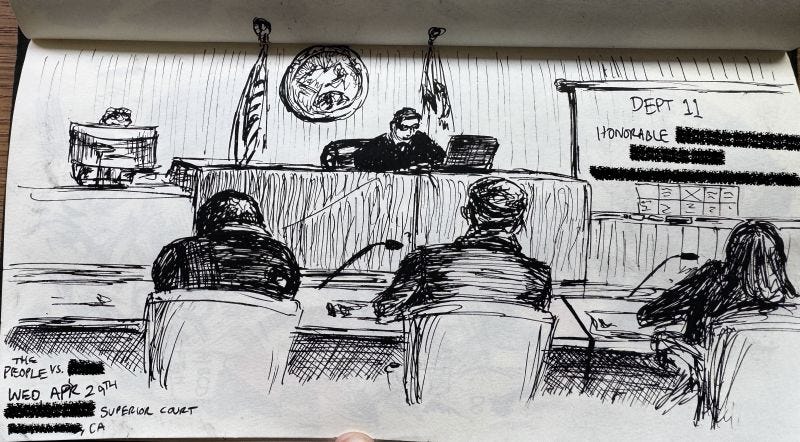
The judge signaled to the bailiff to begin the process of jury selection. They asked each jury member in order from 1 to 25 to answer questions from a sheet. The purpose of this was to identify any reasons why a particular candidate may be unfit to serve on the jury.
As they did the interviews, most people were not shy about making their biases known. A woman said she belongs to a family of police, so she’d always believe police. A man said he felt his peer was wronged by the state, and so he doesn’t believe the state. It was clear they were trying to get out of there as soon as possible. The judge would respond asking, “Even though you have that bias, can you put it aside? Can you be aware of the bias but not let it influence your judgement, so that you can give a defendant a fair trial?” At this, they would say, “I’d like to think so.” The judge took this as an affirmative response that they were willing to go on.
I never quite understood that line, “I’d like to think so.” What does that even mean? It seems like it means you don’t believe it now, but you’d like to believe it. It’s like you’re saying, “Well, I am a pretty biased person and that will definitely cloud my judgement. I’d like to think I’m a good person that can give everyone a fair assessment, but I don’t think I am. I’d just like to think that. It’d be nice if I was a good person, but too bad!”
The more I thought about it, the more I realized it’s a very tricky thing. Overcoming our internal biases is no joke. One of the candidates was a psychologist who went into detail about her understanding of the human mind, and how it is very difficult (she suggested it’s ‘near impossible’) to truly put one’s biases aside. She noted this as a clear reason why she would not be fit for jury.
The judge pushed back. He encouraged each of them to not just give up so quickly. I appreciated that about the judge. Even though later on, once the assessments were made, most of these self-disqualifying folks were indeed disqualified, it was important for him to emphasize that is indeed possible to be fair even when you have biases, and it’s up to us to push ourselves to overcome them.
If we just put our hands up and say, “Well, I’m biased, and so I’m gonna do stuff based on that,” then we’re letting our biases control us entirely, even though we’re aware of them. Often, we speak about unconscious biases—the ones we don’t even know exist—which can influence our behavior strongly without us even knowing. But if we’re aware of them, as the judge pointed out, we should be able to look them in the eye, to see them for what they are, without letting them control our every move. It’s not easy, but I believe it’s doable.
At 4pm, the judge abruptly noted that we would be adjourning and had to come back the next day. Most of us were a bit shocked by this—we didn’t think the “simple” task of jury selection would take more than one day’s session.
Most people were annoyed at having to come back again the next day. I was hiding a smile. I wanted more.
The next day, the defendant’s lawyer and the district attorney took turns asking the candidates a series of questions. They were both looking for any reason why folks might not be able to give a fair trial for either side. Some questions were more personal than others – in one case, a woman was a victim of the same crime being judged here, so she felt herself unable to be impartial. They spent so long discussing it, that I think it probably brought back a lot of trauma for her.
In the end, they dismissed the psychologist, the police-loving woman, the state-hating man. I think the jury they picked and kept was fair, but also felt like some truly qualified people were dismissed in favor of others who simply said nothing of note one way or the other. I guess that’s how it goes.
After the jury was finalized, the rest of the 25 were excused. And then we, the remainders numbered 26-55, were excused as well. Even though I wasn’t in the interviewed 25, because I stayed through the selection, I would be excused until at least 12 months from now. Plus, I apparently would be paid $15 per day and 31 cents per mile for the trouble!
I took my time leaving, walking slowly, looking intently, trying to take in all I could about the place; the shuffling sounds of shoes on a courtroom, the smell of fresh wax on the hallway floors, the rays of light shining on a California State flag, the haphazard handwriting on the whiteboards.
I have fond memories of my time almost joining a jury, and am very glad that I did not choose to postpone. Going in, I certainly didn’t expect to have such positive feelings about the whole thing. I was surprised at how moved I was. Just looking around at the courtroom, the seal, the judge, the benches… it all left an impression on me. There is a powerful atmosphere to a courtroom.
If you get a chance to serve on a jury, I’d suggest you take it. At a minimum, it is a useful window into a process that is often obscured to citizens. And yet, it’s a vital part of how our country works. So much of our exposure to “law” is through the lens of political parties, and what we hear in the news. But that’s not the whole story.
In the hellscape state that America is in right now, this experience was a breath of fresh air, and a much needed reminder that there are still some places that uphold honor, dignity, and grace in this country.
The broadcasts from Washington grow darker by the day, but perhaps we can find a little light in our own neighborhoods.
I enjoyed your saga of being called for jury duty. I agree the process and transparency were a breath of fresh air. I did serve on one short trial and found that equally valuable.
So glad to read this - and to know that so many other citizens welcome our duty to serve.
Also: same title of my musing from a few months ago. Hope you enjoy it.
https://katedelhagen.substack.com/p/jury-duty?r=2ra6i&utm_medium=ios